 Ross Sea, January 1959
Sometime before our departure for the Antarctic, in October 1958, it was agreed upon by Dr. Miller that he would be a guest of the New Zealand Oceanographic Institute on their oceanic cruise aboard the HMNZS Endeavor in January, 1959. Due to circumstances, Dr. Miller was unable to meet the scheduled cruise and being his assistant, I took his place on the ship as the USA representative.
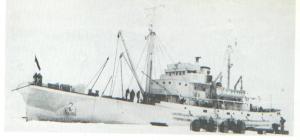
The Endeavor is a wooden ship of 185 feet. It was not an icebreaker and the crew lived in constant fear of being closed in by the pack ice and crushed. There were many of our scheduled stations, which we could not run because of pack ice.
The scientific personnel consisted of five New Zealand scientists and myself. We were scheduled to run 40 research stations when we left McMurdo in January. Due to the lack of time and bad weather, we ran only 20. We had a standard procedure at each station, which was as follows:
- First, a sounding was taken by exploding a submerged hand grenade and calculating the depth of the water by the time it took for the shock wave to hit the bottom and bounce back to the surface. This was the only method of sounding we had.
- Next, when the depth was established, a wire cable was sent to the bottom with a heavy weight and reversing water bottles strapped at intervals from the bottom to the surface. They record temperature, pressure, and bring back a sample of the water at each depth.
- Third, a Bathythermograph record was taken.
- Fourth, we sent a plankton net, a meter in diameter, to the bottom and took a vertical sample, from the bottom to the surface.
- We took bottom samples with a 100 pound orange peel grab to depths of 6000 feet.
- We would then put in the bottom fish trawl/net and pull it for about 30 minutes across the bottom.
Accomplishing the above took from seven hours to as long as fifteen hours, depending on the depth of the water. At a deep station, it would take as much as an hour and a half, just to lower and raise the wire to the bottom and back.
All six of us would work each station. It kept three men busy, just sorting the material and storing it in the containers for three to six hours during each station. The collection and preservation and storage had to be done quickly or the samples would freeze solid on the deck. When several of the men became ill, it increased our workload and slowed our progress tremendously, making the work situation worse.
A storm hit us after we were out for one week, and all operations stopped. The seas became so rough that the captain went off course nearly two-hundred miles because he was afraid of coming around in the seas that were as high as ninety foot waves. When he finally decided to turn, he sent word to all hands that they were to be prepared for a heavy role. The ship came about, but it did take a 62° role in doing so.
There were not many humorous happenings on the cruise. It was cold 98% of the time and just plain hard work. However, there was one situation that we all, well almost all, laughed at.
When the ship was brought about in the storm, and took a 62° role, we were eating breakfast in our scientific quartiers. We ate at a long table that was set across the ship from side to side. There were six of us, three sat on one side, two, on the other side, and one on the end of the table. Breakfast on the New Zealand ship started every morning with a bowl of oatmeal. It was served in a heavy bowl with a wide-spreading brim around the edge. Each of us had a space in front of us that was fenced in with a little wooden fence, about one inch high, so our food wouldn’t slide as the ship rolled from side to side. This is standard on many oceangoing vessels.
We were in the oatmeal part of our breakfast, when the captain decided to come about. That was when we took the 62° role. All six of us thought we were going to capsize, and grabbed the table to keep from falling over onto the floor. That left six bowls of oatmeal free to slide over the little fences, bump-bump-bump, and onto the man at the end of the table, who had to let go of the table to protect himself from the flying oatmeal bowls, and was now flat on his back covered in oatmeal.
Once the boat came back from the role, and we decided we were not all going to die, we couldn’t stop laughing at our slimy comrade. It took about two days before he started to laugh.
We caught 93 fish, which we preserved. I got to bring them home with me when I left the ice, and take them back to Long Beach State College, on loan from New Zealand, to work on my Master’s degree with them.
The next blog will tell the story of how the fish got to Long Beach to be studied….Funny.
 John's Book of Life