• ABOUT JOHN

John's Book of Life

~ From the Old Man at the End of the Street

John's Book of Life

Category Archives: Education and Teaching

Teaching Stories at the College

28 Wednesday Sep 2016

Posted by John's Book of Life in Education and Teaching

≈ Leave a comment


After teaching for two years at Valley High School, I took a semester off to try a different field. I decided that teaching was really my calling, and I returned to it. I taught at Santa Ana High School for one semester, and then had the opportunity to move to Santa Ana Community College. I spent the next 28 years there. During my time there I taught many different courses. I taught biology, marine biology, physical oceanography, SCUBA diving, martial arts, archery, and survival courses, along with helping develop science teaching for the grammar school program. I also taught part-time at UCLA, UCI, Cal State Fullerton, and Orange Coast College at night and on weekends.

The community college is, I think, the premier place to teach. Most of the students there are there to truly get an education, not because their parents said they had to go to school. They live at home, so they study, instead of partying – which is really easy to get caught up in when you are, ‘away at school’. Many need a little extra help, or encouragement, to make it through. In the junior college it is easier to come by those things, than it is in the university. In my 28 years of teaching at the College, I have hundreds of stories, and I will share just a few of them with you.

Trash

One afternoon I was on my way to have lunch at our cafeteria and was walking across the Commons area, which was full of students, walking in all directions, going this way and that.

There was a handicap, female student a ways in front of me, walking with two crutches, the kind that are not temporary. I saw her stop, and with great effort, bent down and picked up some trash that everyone else was just walking over. She put it in her bag. She had my attention now, so I watched her. She made her way to a trashcan some 50 feet away, and put the trash in the can. Then she went on her way.

I was so impressed with the effort she put out to pick up the trash, and the attitude it took for her to do it, when everyone else, including me, was just ignoring it. Ever since that day, I have picked up trash whenever I see it. It may not be mine, but I live on this earth, and I don’t want trash where I live. And besides, it’s the right thing to do. She entered my life again several years later. (See the Yawara story.)

yawara

The Yawara Stick

One of my martial arts classes that I taught was self-defense. The way I taught it was a mixture of judo, karate, and just good old street fighting. When you are defending yourself, there are no rules. It helps if you have a weapon of some kind, and know how to use it. Most weapons are illegal to carry, so most of us don’t have one with us when we are out and about.

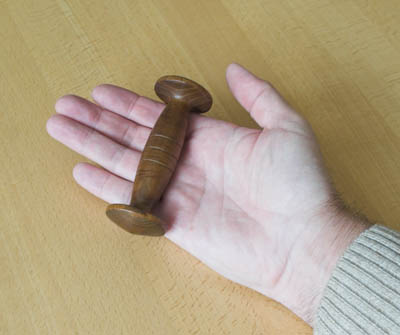
I taught my students how to make a weapon and have it on their person all the time, and never have it questioned. It was my version of a yawara stick. It consisted of a dowel that was cut just to the length of the width of your palm, from the thumb side, to the little finger side. A big hand would use a ¾ inch Dowel, a small hand used a ½ inch dowel. On each end a small knob, like the ones on drawers, was screwed on. Then you painted it some wonderful pattern that you liked. Perhaps like a totem pole, and place it on an aluminum chain, then carried it around your neck as a necklace. It made a wonderful conversation piece when people asked you what it was. Make up a good story. My story was that an Indian friend gave it to me as a symbol of friendship, and protection.

When needed for self-defense. It was accessible with either hand, the aluminum chain broke easily, and it was a devastating weapon when you knew how to use it. I taught my students how to use it, and they all made themselves one for about two dollars.

Now the best part. One of my self-defense classes was for the physically challenged. I was disgusted when my students in that class told me how many times they had been targeted by thieves – they were easy, soft targets. ATM machines were the worst spot. They would take their money out, someone would grab them from behind, or knock them down, and take the money.

My girl with the two crutches, from the trash story showed up in my class. She didn’t know anything about what I knew about her. As it turned out, she had been robbed three times at her local ATM where she went to get her money.

Because of their various handicaps, everyone in the class had to have individual training on how to use the yawara stick. I worked with each one of them until they were proficient in its use. I loved these classes – every one of them had an immediate need for what I was teaching, and worked very hard to learn. They were very special people, and truly an inspiration to me.

I was in my office one day, when the phone rang. It was my crutches girl. She was so excited she could hardly talk. I told her to slow down, because I was hard of hearing and had trouble hearing on the phone. She told me she had just been attacked again at her ATM. A man had grabbed her from behind. She grabbed her yawara stick from her neck, broke the chain, and slammed it into his knee. When he fell down she hit him in the head with it. She was very strong in the arms from using crutches, all of her life. He went down to the ground and was still there when the police arrived. She had a cell phone. Don’t you just love it?

`


The fish Part #2

13 Friday May 2016

Posted by John's Book of Life in Education and Teaching, Personal Philosophy, Uncategorized

≈ 3 Comments


P1020480

What have we learned so far?

A child’s mind wants to know the answers to every question they encounter. If you give them an answer the question is closed.  Once it is closed it is hard to reopen because they already know the answer.  Dr. Hubbs didn’t answer my question, he lead me on a path of discovery and showed me how to answer it.

The path of discovery has no end; I’m still on it.  If he would have just said, “That is a ratfish.” I would have probably become a mechanic like my father instead of a biology teacher, because the issue would have been closed.

Now the rest of the story.

Twenty years later I was visiting Scripts Institute of Oceanography as a graduate biology student from Cal State University at Long Beach.  In my wanderings I discovered a room full of fish specimens.  The main interest and emphasis in my education was ichthyology, (fish) and I was looking at the specimens in the bottles when I came on one that caught my eye.

It was a ratfish in a bottle.  There were several there but this one was different because the label on it was incomplete.

The date was there, twenty-years earlier.  The location was there, Cardiff in the surf,  but under collected by, it just said Johnny.

I was standing there with the bottle in my hand when a man walked in and smiled at me as he walked to a desk in the corner of the room.  I recognized him from his picture in some of the articles I had read.  It was Dr. Hubbs.

I walked over to him with the bottle in my hand and said, “I have a question.”

“I hope I have an answer.”  He smiled back.

“I was looking at this specimen and I noticed the information on the label is not complete.  I was wondering why?”  I handed him the jar.

He looked at it and said, “Oh, you mean the name of the collector?  Well, that’s the only name I got.  It was a young boy that brought it in and I didn’t get his full name.”

I said, “It isn’t an unusual specimen, how come you kept it?”

“I kept it to remind me what biology is all about.  The wonder the young man had and the sheer delight that showed in his eyes when he discovered what the fish was is what I think of whenever I get discouraged.  That curiosity and joy of discovery is what science is all about.

Sometimes we get too close to the project to remember why we are doing it in the first place.  When I need reminding I come down here and look at that fish, and I remember why I like what I do.”

I said, “Well, I think you should complete the label, the last name is Reseck, Johnny Reseck Jr.” and I held out my hand to him.  He took my hand in both of his and didn’t say a word.

Tears came to his eyes and he came around the desk and gave me a hug.  He said, “Thank you for coming back and completing the label for me.  I have wondered so often whatever happened to that young man.”

We had a long talk. We talked about fish, and school, and research, but mostly we talked about why it is so important to wonder.  I never saw Dr. Hubbs again.

What did I learn?

I learned even important men who are leaders in their field get discouraged from time to time, and it is okay to have a crutch to help you through those hard times, even if it’s just an old fish in a bottle.  I once told a friend who was going through a hard time that he needed a fish in a bottle and he thought I  was crazy.

I also learned the importance of wondering.  I define wondering as the combination of curiosity and excitement.  Every child is good at it.  Most adults have lost it to become politically correct and fit into their slot.

Don’t lose it, because it makes life an adventure instead of just a voyage.

NOTE:  Dr. Carl Hubbs was one of the world’s leading ichthyologists.


Why I became a marine biologist

07 Saturday May 2016

Posted by John's Book of Life in Education and Teaching

≈ 2 Comments


THE FISH

 This story makes me cry every time I think about it, but then I cry easy.  I’ve never been ashamed to cry when I encountered a happy or a sad circumstance.  If someone laughed at me I just figured they hadn’t experienced that particular circumstance, or were to macho to show their emotions.  I felt sorry for them and hoped they would mature soon.

I was about five years old when one of the most significant events in my life happened to me. My father being a welder and mechanic for Blue Diamond building materials only had a two week vacation each year and we spent it camping at a beach close to home in San Diego County, California.

There was no campground, just a beach and some cliffs that would shield us from the north wind that blew most every afternoon.  The campsite was free, and the fishing was good. It just doesn’t get any better than that.  There is a state park there now.  It is San Elijo State Park in Cardiff, California.

The great tent sites, back in the dunes have been bulldozed flat now so the RVs will fit on them.  The four or five families that camped there every year has become four or five thousand and there is a traffic problem in the campground.  I don’t go there anymore.

My story is about a five year old boy fishing in the surf with his father.  The accepted procedure was to wade out to about your waist and cast your bait out so it landed just beyond the first breaking wave.  My father taught me to cast sometimes before I can remember, and I was a good fisherman, (in those days you could still say the word fisherman and you wouldn’t get sued, or fired, or anything.

Early one morning, just as the sun was starting to spread its gold across the land, (all of us that didn’t have any money to spend always had the suns gold to make us rich), I hooked a fish.  Little did any of us know that it would set the entire course of my life.

I remember the fish didn’t fight very much.  I could feel he was on the line because of the jerks he managed every once in a while as I reeled him in through the surf.  I was taught to be cautious when landing any fish in the surf because the action of the water could rip a fish right off the hook.

I got the fish coming towards the shore, then I reeled as fast as I could and backed out of the water as I had seen my father do all my life.  The fish came flopping out of the water onto the sand beach, and I ran down and grabbed it.

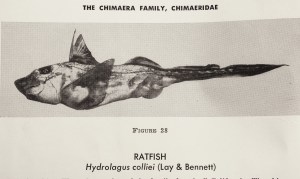
I ran back up the beach so the next wave wouldn’t get me, and looked at my fish.  It was awesome.  I had never seen a fish that looked like this one before.  It wasn’t very big.  Perhaps 12 or 14inches, but it was so silver and bright, and such a strange shape.

It had very big eyes and they were green.  The body didn’t have scales on it like most of the fish I was used to catching, and as the sun shined on it, many colors glimmered and then disappeared.  It had a head that seemed out of proportion to the skinny tail, and a big spine that stuck up out of the back.

There was a line that ran down both sides like a lot of fish have, but this one was really easy to see.  There were spots all over the back, and as I held it in my hands it seemed to lose its color and turn more grayish.  I realized as it was dying all the beauty it had in life was evaporating like a puddle of water as it dries up.  It made me sad but my excitement at catching this stranger from the sea overcame the sadness, and I ran to show it my dad. (He became Pop later in life to everyone.)

He looked at it, scratched his head and said he didn’t have a clue as to what it was.  He had been fishing these shores all of his life, but this was a new one even for him.  He suggested we walk down the beach and talk to a man who was fishing a few hundred yards away. He might know what it was.

We waded out into the water and met Mr. Sergeant.  It is strange that I still remember his name.  When a child is excited they remember everything.  After careful examination, Mr. Sergeant said he didn’t know what it was, but he knew how we could find out.

He asked if my dad and I would like to ride over to the marine science school that was just a few miles away in La Jolla.  He said someone there was sure to know what it was.

We check with my Mom and she said it was okay with her, and off we went to the marine science school to find out about my fish.

The marine science school turned out to be Scripts Institute of Oceanography in La Jolla.  It wasn’t the big impressive campus it is today.  It only had a few building as I remember.  The place we went was a low woden building with a lot of offices off either side of a long hall.

There was a lady at a desk as we came in the door, and she greeted us with smile.  Her smile got bigger when I proudly held up my fish and asked her what it was.  She asked if that was why we were there.  Mr. Sergeant told her yes it was.

She leaned over and looked at the fish and said it was far too strange a fish for her to know, but she knew a man that would know what it was.  She picked up the phone and spoke to someone for a couple of minutes and then told us Dr. Hubbs would see us.

I walked down the hall with my dad and Mr. Sargeant to a door that had, ‘Dr. Hubbs,’ written on it.  I remember thinking he must really be important to have his name written on his door.  When we went in I saw books everywhere.  They were on the desk, on the table, and in bookcases that covered all the walls.  I was sure this man would know what my fish was.

He was very nice and talked to my dad and found out where we caught the fish and how excited I was about it.  He then turned to me and from that moment on he paid no attention to my dad or Mr.Sergeant.

He took the fish in his hands and didn’t seem to worry about getting the fish slime on his hands at all.  He looked at it for a long time.  Finally, I couldn’t wait, and I asked, “Do you know what it is?”  He could have said, a rat-fish, and we would have been out of there, but he didn’t.

He said, “No, but I know how to find out.”

He then led me to a stack of books and we started looking through them.  He didn’t just find a picture; he took me through a biological key.  We had to decide if it had scales, and what a lateral line was, and did it have rays in the fins or not.  He made me see the fish, not just look at it. At long last we discovered it was a rat-fish.  I was elated.  The book even told us all about the fish.

We said goodbye to Dr. Hubbs, and as we left he asked if he might keep the fish for the museum.  I was proud he wanted it, and was happy to leave it.  He had said it wasn’t good to eat anyway.

I stayed fascinated not only with fish but with the fact you could take any fish and find out what it was by using the right biological key.  My interest in biology dominated my school years and, twenty-five years later, I finally became marine biologist.  Dr. Hubbs never left my thoughts during all those years.

That should be the end of the story but it is not. You’ll have to read my next post in a week or so to find out why I cry when I think about this story.

A TEACHER TO REMEMBER

26 Tuesday Apr 2016

Posted by John's Book of Life in Education and Teaching, Uncategorized

≈ Leave a comment


A Teacher to Remember

(I love this story)

Two years after I retired and moved to Port Ludlow in Washington State on the Olympic Peninsula, I got a call from Peninsula College.  They needed a part time Marine Biology teacher in a hurry.  The teacher they were planning on to teach a marine biology course off the main campus in Port Townsend became unavailable.  The class was in their class schedule and was full with 25 students.  It was to start in four weeks.

I hadn’t been teaching for a while and jumped at the chance to get back into the classroom with the future leaders of our country teaching my favorite subject.

The class was to be held at the Marine Science Center on the end of the pier at Fort Warden State Park in Port Townsend.  That was good news and bad news.  Being 45 miles away from the main campus, all the normal lab supplies were not available.  They had microscopes and a few prepared slides but that was all.  The good news was there were a dozen major aquariums in the building that we could use, and being my only class I had time to collect live specimens to use in our lab sessions.

It worked out well and I had a great time mixing with the younger generation again.  I stayed for six years.

Like in any class there are things that occur that were unplanned that you remember as special.  This is the story of one of those occurrences.

The lab session for this particular night was to look at live plankton.  Plankton is mostly very small animals and plants that drift in the ocean.  To catch and look at it under the microscope we use a ‘plankton net’; which is a very fine mesh butter fly type net.

This evening my plan was to have the class go down to the dock on the pier and pull the net along the dock, then go directly to the classroom (100 feet away), and watch the live specimens swimming around through their microscope.

Not wanting to get caught flat-footed I came an hour early and went down to the dock to check if there were enough plankton in the water to catch.  Sometimes the water was clear and almost no plankton would be in it, then I would switch to a different exercise.

The ramp down to the dock was forty feet long and as I walked down, the eight river otters that were resting on the dock all went back into the water.  They used the dock all the time and it was covered with otter poop.  As I was tiptoeing between the piles, I had a sudden realization that the poop on the dock looked exactly like the ‘Cliff Bar’ I was in the process of eating, as my ‘before class’ snack.  I broke off a good size chunk and placed it on a ‘clean’ spot at the edge of the dock, and went back up the ramp to meet my class.

An hour and a half later after my lecture, the class got their plankton nets and we all marched out to the dock to collect our lab material for the 2 hr. lab that was to follow.

There were a couple of otters on the dock that hit the water when we came down and I announced to the class to be careful not to step in the poop.  They all became very aware of it all over the dock.  I had them now – the con was on.

I said, “I wonder if they were males or females.”  I was sure one of them would take the bait, and one did. College students are always interested in sex.

“How can you tell?” was the question from the crowd.

I said, “It’s easy, the females have estrogen in their feces and it makes it sweeter than the males.”  I bent over, picked up my planted Cliff Bar, and popped it in to my mouth.  “This one is a male,” I said spitting it out, and going on with the class collecting like nothing had happened out of the ordinary.

Those 25 students may not remember much about marine biology as they grow old, but they will never forget the teacher, and have a great story to tell to their grandchildren.  Don’t you just love it when a plan all comes together?


Subscribe

  • Entries (RSS)
  • Comments (RSS)

Archives

  • December 2025
  • March 2025
  • December 2024
  • September 2024
  • August 2024
  • July 2024
  • June 2024
  • May 2024
  • April 2024
  • December 2023
  • April 2022
  • December 2021
  • October 2021
  • September 2021
  • August 2021
  • July 2021
  • June 2021
  • May 2021
  • April 2021
  • March 2021
  • February 2021
  • January 2021
  • December 2020
  • November 2020
  • September 2020
  • August 2020
  • July 2020
  • June 2020
  • July 2018
  • June 2018
  • April 2018
  • March 2018
  • January 2018
  • October 2017
  • September 2017
  • August 2017
  • June 2017
  • May 2017
  • April 2017
  • March 2017
  • January 2017
  • December 2016
  • November 2016
  • October 2016
  • September 2016
  • August 2016
  • July 2016
  • June 2016
  • May 2016
  • April 2016
  • March 2016

Categories

  • Diving
  • Education and Teaching
  • kayaking
  • Personal Philosophy
  • Tips for a Happy Life
  • Uncategorized

Meta

  • Create account
  • Log in

Blog at WordPress.com.

  • Subscribe Subscribed
    • John's Book of Life
    • Already have a WordPress.com account? Log in now.
    • John's Book of Life
    • Subscribe Subscribed
    • Sign up
    • Log in
    • Report this content
    • View site in Reader
    • Manage subscriptions
    • Collapse this bar
 

Loading Comments...