• ABOUT JOHN

John's Book of Life

~ From the Old Man at the End of the Street

John's Book of Life

Category Archives: Uncategorized

Dr. Sammy Lee

19 Monday Dec 2016

Posted by John's Book of Life in Uncategorized

≈ Leave a comment


dr-sammy-lee

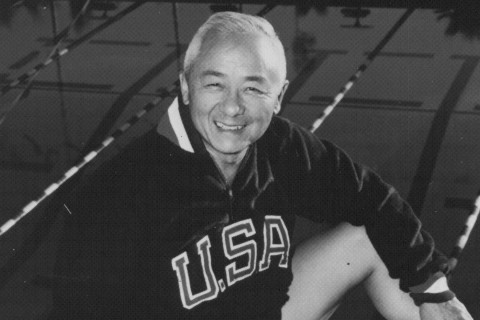
I just read that Dr.Sammy Lee passed away. If you don’t recognize the name, he was famous nationally for bringing home to the USA several gold medals in the early Olympics in diving. He also was a major player in the civil rights movement. He’s worth a Google, if you’re young enough not to know of him. I was lucky enough to know him personally.

Sammy came to Santa Ana College where I taught SCUBA diving classes and helped to mentor our springboard divers. He taught them how to look good diving into the water, and I taught them how to stay alive and have fun under the water.

He became my hearing aid doctor early on in our relationship, and worked with, and on me, for many years before I retired and moved north to Washington State. This story is just one of many that could be told about Sammy, but it will give you an insight as to why everyone seemed to love him.

As I mentioned above, Sammy was a doctor that worked on the hard of hearing folks like me. His office was in Santa Ana and I was a regular customer/patient. His examination of me revealed that the outer ear canal, from the outside to the eardrum, was closing off. He thought it was occurring because of the constant exposure to cold ocean water. As a diver and instructor, I spent extensive time in the ocean. He said he could open them back up with an operation called an “exostosis”.

We made arrangements for me to check into the hospital to have both ears done. Remember, this is over 45 years ago when we didn’t have the equipment we have today, and it was a serious surgery then. I think it is more common now. They call it a surfer’s ear.

I checked into the hospital one afternoon, and spent that night. There were various tests done to get me ready for surgery in the morning. They wheeled me in, put me to sleep, and I woke up feeling just fine. Sammy said all went well and I could go home that afternoon.

When the time came for my release, (it sounds like I was in prison), they wheeled me out to the street in a wheelchair and I got up and started walking home. I only lived two miles from the hospital and didn’t have anyone to pick me up, so I planned to just walk home. I wasn’t hurting anywhere.

I had walked for about a half mile, when a car suddenly slammed on the brakes, and stopped alongside me on the road. I looked over and it was Sammy staring at me through the car window. He opened the door and said, “What are you doing out here? “

I told him I was just walking home. He said, “You can’t do that, you just had some major surgery.”

I said, “It doesn’t feel like it. I feel fine.”

His answer was, “If you don’t think it was major surgery, just look at your bill.” I got in the car still laughing. Sammy drove me home.

He was a dear friend, a credit to his country, a good doctor, and the world, country, and many others, like me, will miss him. People of his caliber are few and far between.


Getting the Fish Home – a continuation of the last post

01 Thursday Dec 2016

Posted by John's Book of Life in Uncategorized

≈ Leave a comment


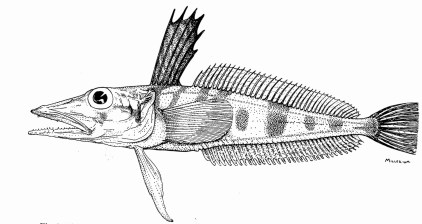
chanodraco078

Chionodraco rastrospinosu

The bucket we found to carry the fish had been used to send something down to the station sometime in the past. There were no stores at McMurdo Station, and we saved and reused everything. This bucket was ugly. It was black, with yellow and red paint all over it, because it had been used several times for one thing or another. The top had a lid we could seal, with about 30 little tabs that could be bent down to lock it in place. It had a handle, and I carried it with me on the way home, never letting it get out of my sight.

At the end of the cruise, the 93 fish that were collected were very carefully injected, wrapped in cloth, and placed in the 5 gallon bucket. They were small, most about 6 inches. They belonged to New Zealand, and were loaned to me to take home and work on. This collection of fish was one of the main reasons for the entire expedition, and I had it, in a bucket, to carry home. It was a very heavy responsibility.

The trip home for me started on a ship, from the station to New Zealand. The bucket shared my bunk. In New Zealand, I had to wait for a military air transport flight to San Francisco, and the bucket shared my room with me. The flight to San Francisco was long, we didn’t have jets then, and the bucket shared my seat with me. We landed at Travis Air Force Base, in San Francisco.

They put me in a car and drove me to the San Francisco airport, where I would take a regular commercial flight home, to Southern California.

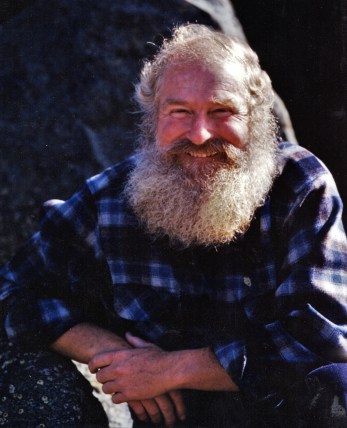
I had been gone for about five months. I had not shaved or cut my hair in that time. I had bright red hair down past my shoulders, and a full red beard all over my face. When I was on the ice, everyone look like that, but it was 1959, and the hippy movement hadn’t become popular in the cities yet, and I was to the city person, some sort of mountain man, and probably mentally deficient.

I was wearing a red plaid, wool shirt, and an old pair of wool Army issued pants. To make the picture complete. I was carrying my ugly bucket in one hand and my ice ax and my steel crampons in the other hand, because I couldn’t find any way to pack them. Can you imagine what would happen now, if I tried to get on an airplane with an ice ax and a bunch of metal crampons?!

I walked up to the counter to buy my ticket, set my bucket down and was totally unaware of how I was affecting those around me; I just asked for the first flight out to Los Angeles. The lady behind the counter, told me there is a plane leaving in 20 minutes, I think she just wanted to get rid of me as fast as possible, and gave me a ticket. I took my ticket, and reached down to pick up my bucket, and it was gone.

I panicked! I grabbed a lady standing next to me at the counter and said, “Did you see what happened to my bucket?”

bearded-john047

Red Beard

She didn’t say anything. Her eyes were as big as saucers as she was shaking. I realized later that she was terrified from looking at me. Her husband said, “The custodian took the old bucket away that was sitting on the floor. Is that the one you mean? There he goes, over there,” and pointed. I looked through the crowd of people that were milling around, and he was headed for a door that said employees only. I panicked about losing my bucket, and being late for my flight, and ran after the man, calling out, “That’s my bucket.” and waving my arm in the air to get his attention. It just happened that the arm I was waving was also holding my ice ax and my crampons. People scattered, and I suddenly had a clear path to the custodian. I reached him just as he got to the door, and he, for the first time, heard me and turned around. I was right on him, waving my ice ax; he dropped the bucket, and slammed himself against the wall.

I didn’t have time to explain anything, I had to catch my flight. I picked up the bucket and just said, “That’s my bucket.” Then I turned and ran to catch my plane again. The people gave me a clear path, even though I was no longer waving my ice ax around.

I made my plane and sat in the backseat, by myself, okay with my bucket and ice ax. The flight attendant came back after we got in the air, and in a nice calm voice asked, ‘Where are you coming from?” I told her the Antarctic, and she asked, “How did you get to the San Francisco airport?” I told her it had all been military transportation. She just said, “Well, that explains a lot,” and left. It wasn’t until then, that I realized what had just happened. I chuckled to myself all the way home.

When I got home, I looked in the mirror and I even scared myself.

Oceanic Cruise of the HMNZS Endeavor

20 Sunday Nov 2016

Posted by John's Book of Life in Uncategorized

≈ Leave a comment


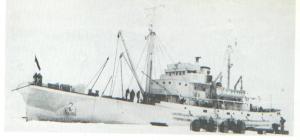
endeavour_1Ross Sea, January 1959

Sometime before our departure for the Antarctic, in October 1958, it was agreed upon by Dr. Miller that he would be a guest of the New Zealand Oceanographic Institute on their oceanic cruise aboard the HMNZS Endeavor in January, 1959. Due to circumstances, Dr. Miller was unable to meet the scheduled cruise and being his assistant, I took his place on the ship as the USA representative.

The Endeavor is a wooden ship of 185 feet. It was not an icebreaker and the crew lived in constant fear of being closed in by the pack ice and crushed. There were many of our scheduled stations, which we could not run because of pack ice.

The scientific personnel consisted of five New Zealand scientists and myself. We were scheduled to run 40 research stations when we left McMurdo in January. Due to the lack of time and bad weather, we ran only 20. We had a standard procedure at each station, which was as follows:

  • First, a sounding was taken by exploding a submerged hand grenade and calculating the depth of the water by the time it took for the shock wave to hit the bottom and bounce back to the surface. This was the only method of sounding we had.
  • Next, when the depth was established, a wire cable was sent to the bottom with a heavy weight and reversing water bottles strapped at intervals from the bottom to the surface. They record temperature, pressure, and bring back a sample of the water at each depth.
  • Third, a Bathythermograph record was taken.
  • Fourth, we sent a plankton net, a meter in diameter, to the bottom and took a vertical sample, from the bottom to the surface.
  • We took bottom samples with a 100 pound orange peel grab to depths of 6000 feet.
  • We would then put in the bottom fish trawl/net and pull it for about 30 minutes across the bottom.

Accomplishing the above took from seven hours to as long as fifteen hours, depending on the depth of the water. At a deep station, it would take as much as an hour and a half, just to lower and raise the wire to the bottom and back.

All six of us would work each station. It kept three men busy, just sorting the material and storing it in the containers for three to six hours during each station. The collection and preservation and storage had to be done quickly or the samples would freeze solid on the deck. When several of the men became ill, it increased our workload and slowed our progress tremendously, making the work situation worse.

A storm hit us after we were out for one week, and all operations stopped. The seas became so rough that the captain went off course nearly two-hundred miles because he was afraid of coming around in the seas that were as high as ninety foot waves. When he finally decided to turn, he sent word to all hands that they were to be prepared for a heavy role. The ship came about, but it did take a 62° role in doing so.

There were not many humorous happenings on the cruise. It was cold 98% of the time and just plain hard work. However, there was one situation that we all, well almost all, laughed at.

When the ship was brought about in the storm, and took a 62° role, we were eating breakfast in our scientific quartiers. We ate at a long table that was set across the ship from side to side. There were six of us, three sat on one side, two, on the other side, and one on the end of the table. Breakfast on the New Zealand ship started every morning with a bowl of oatmeal. It was served in a heavy bowl with a wide-spreading brim around the edge. Each of us had a space in front of us that was fenced in with a little wooden fence, about one inch high, so our food wouldn’t slide as the ship rolled from side to side. This is standard on many oceangoing vessels.

We were in the oatmeal part of our breakfast, when the captain decided to come about. That was when we took the 62° role. All six of us thought we were going to capsize, and grabbed the table to keep from falling over onto the floor. That left six bowls of oatmeal free to slide over the little fences, bump-bump-bump, and onto the man at the end of the table, who had to let go of the table to protect himself from the flying oatmeal bowls, and was now flat on his back covered in oatmeal.

Once the boat came back from the role, and we decided we were not all going to die, we couldn’t stop laughing at our slimy comrade. It took about two days before he started to laugh.

We caught 93 fish, which we preserved. I got to bring them home with me when I left the ice, and take them back to Long Beach State College, on loan from New Zealand, to work on my Master’s degree with them.

The next blog will tell the story of how the fish got to Long Beach to be studied….Funny.

A Friend Missed

22 Saturday Oct 2016

Posted by John's Book of Life in Uncategorized

≈ Leave a comment


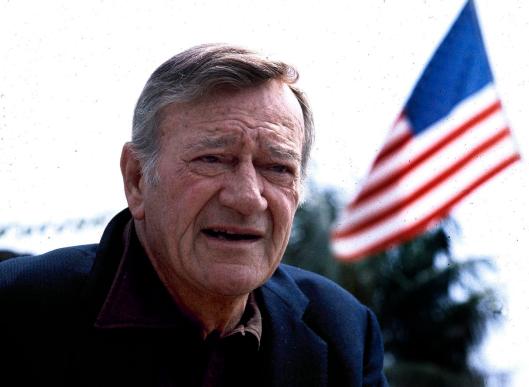
John Wayne

I was living on a 40 foot sailboat, I rented for a year, and had the opportunity to make a friend that I didn’t take. It is one of the few things in my life that I would change if I could.

The boat I lived on was kept in a slip in Newport Beach, California. I was renting it for only $50 a month because the owners had two, full-size, Standard poodles aboard that I was looking after, while they were on a year-long teaching assignment out of the country. I took the two dogs for a walk at 6 AM every morning before I went to work at Santa Ana College.

One morning, as the dogs and I were finishing our walk, a man came out of his house and picked up his newspaper from the lawn. He was in a bathrobe and slippers. I knew who he was, and I knew that he lived there – everyone knew he lived there.

He was only 15 feet from me, so I said, “Good morning, John.” He looked up at me and I could tell he was trying to figure out who I was, so I continued the conversation with, “I thought about saying good morning Duke, but I don’t know you well enough to do that. I also considered good morning Mr. Wayne, but I’ve seen all of your movies, and that seemed too formal. The only thing left was John.”

He broke into a real belly laugh at that and said, “Come on in and have a cup of coffee.” Then I made the only big mistake I ever made in my whole life.

I said, “Thank you, but I have a class waiting for me at the college. I have to be there by 8 o’clock.” We said a few more words back and forth and laughed a little bit and then I took the dogs and we went back to the boat, and I went to work.

 My mistake was entirely my father’s fault, he’s the one that taught me my work ethic.


Close Encounter of the Eight-Legged Kind

13 Thursday Oct 2016

Posted by John's Book of Life in Uncategorized

≈ Leave a comment


octopus2

This isn’t Dave, but it’s a good picture.

octopus

This isn’t Dave, but it looks a lot like him.

I have made many good friends in the diving world, one of them is Dave McLaren. I met Dave at Simon Fraser University in British Columbia, Canada. When I was the course director of a diving instructors program. He was on my staff. Dave now lives in Texas. He has been reading my blog and contacted me about an article he wrote for a magazine in British Columbia in 1991. He thought my blog readers would enjoy reading it. He sent it to me, and I agreed, so I retyped it. If there are any errors in it, it’s my typing, not his, and I left some out to shorten it for the blog.
“The waters off Canada’s West Coast team with life………….. One of these creatures, the octopus, is startling divers and scientists by displaying large amounts of an unsuspected quality: intelligence. Long believed to be the evil devilfish, lying in wait to reach out and drag unwary fisherman screaming to their dooms, the octopus is, in truth, a shy, timid creature who wants above all to be left alone……….. Cousteau after studying the octopus, called it the “soft intelligence.”
Some years ago, I had occasion to meet an octopus informally. Intimately.
We were returning from an enjoyable but uneventful dive off of Whytecliffe Park in West Vancouver, and were making our way slowly upward along a fissure in the rock face. An octopus was gliding on his tentacles down the same fissure, when we met at a depth of 30 feet.

We estimated him to be 12 feet across as he backed slowly and wearily into a recess. He curled his eight tentacles beneath himself and sat watching us. I reached out with one finger on my gloved left hand, and stroked him gently between the eyes, which diver lore said would pacify him. He backed up a little more, staring impassively at me with his unwinking, golden eyes. I stroked him again, and he stopped backing away, so my companion and I vented (the air out of) our suits and settled on the bottom to enjoy his nearness. For several minutes divers and octopus watched one another’s movements.
I looked over at Ann Williams, my diving buddy. She was grinning with delight, her shoulders hunched in a characteristic gesture of hers that says, “Wow!”
One tentacle moved from beneath the octopus’s body, slowly uncoiling toward me, until the delicate tip touched my left mitt. It was as if we could hear him thinking, “Hmm… normal temperature; soft; no mucus membrane.”
The tentacle moved up the arm of my nylon suit. “Different texture.”
The tip touched the face of the gauge on my arm. “Different texture again! What are these creatures made of?”
The tentacle moved smoothly, walking on sucker disks until it lay up my arm, from my fingertips to my shoulder. A second tentacle uncoiled then as the octopus, his curiosity fully around, continued his investigation of the two strange beings who had entered his domain. It touched the Mitt on my right hand, and worked its way up past my elbow to my shoulder, giving tentative tugs along both arms as if to assess mass and holding power.
“So far, so good,” he seemed to conclude. “The creatures seem passive and friendly. Perhaps touching between the eyes is a gesture of friendship in their home area. I’ll try it.”
A third tentacle uncoiled, whip-like, through the water, faster this time, more confident. It’s touched my forehead above my mask, and began exploring. It moved over and around my hood, onto my mask faceplate, down on to my regulator mouthpiece. The octopus’s thoughts were clear: “This part is moving.”
He gave light tugs on the regulator second stage. The sensitive tentacle tip moved over my rubber mouthpiece and touched my beard. There was a momentary hesitation, a drawing back, then it touched my beard again. “Parasitic growth?”
The probing continued, touching my lip. I felt the tentacle tip probe between my lips and touch my teeth on the right side of my mouth. It moved slowly into my mouth along my teeth, all the way back to my molars. I thought about the movie Alien.
At this point, I felt the exploration had progressed far enough, and gently shook my upper body, head, and arms.

The octopus immediately let go with all three tentacles. He did not withdraw them, though, and after a few seconds, he gently put them back on me. Again I gave a slight shrug, and again the octopus let go. This time, he retracted his tentacles to their original position beneath his body.  His thoughts reached us through the water. “I must have frightened them. Sorry about that!”
We regarded one another quietly for another few moments, then the octopus moved away from the wall, toward Ann and me. Unhurried and unworried, he passed between us, moving down the seabed to deeper water. We watched him amble off, remaining stock–still ourselves. He neither stopped nor look back.
Ann finally nudged me on the shoulder, indicating that we should resume our ascent. Reluctantly, we did.
Back on shore. We must have looked like a pair of fools. We couldn’t stop grinning all day.”

I hope you enjoyed this as much as I did. Thank you Dave McLaren.

Diving in the 50’s

22 Monday Aug 2016

Posted by John's Book of Life in Uncategorized

≈ 2 Comments


Catalina 1953 Diving buddies in the streets of Avalon.

Catalina 1953 Diving buddies in the streets of Avalon. Left to right… Marshall, Cliff, Bob, Dave. John, on the way to Lovers Cove to get dinner.

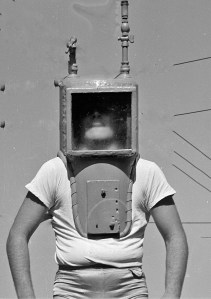
First hardhat 1952

First hardhat 1952, made out of an old water heater. It was called a displacement helmet.If you bent over, it instantly filled with water.

The Glass Bottom Boats

25 Monday Jul 2016

Posted by John's Book of Life in Uncategorized

≈ 2 Comments


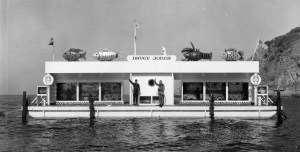
dad scubaMy summers diving with the Hansens, on Catalina Island, brought me to the attention of Harold Warner. Harold was the diver for the glass bottom boats. He had a barge parked in ‘Lovers Cove’, just south of Avalon, (it is the barge with the aquariums on it in the picture on the post How I Got to Work on Catalina Island. I’m the one on the right.) This cove had great kelp beds and lots of fish in it, and was where the glass bottom boats took their passengers to see the marine life in the Marine Gardens

The glass bottom boats came into the cove, and during their route through the Garden would stop at the diving barge. The diver swam under the boat holding a hunk of fish in his hand and the local fish knew that they could get a few bites, if they got there quickly enough. The diver regularly had several hundred fish trying to eat his hand. It was a good show.

The two big paddlewheel boats had a glass section in the bow and one in the stern. It took two divers to put on a good show, because the time was limited due to the number of trips the boat made each day. There were four boats, two big ones and two small ones.

Harold offered me the job of being the second diver the next year, when I came back to the island. Now I was in heaven. We used scuba gear, and I would work seven days a week for the entire season, that was Memorial Day to Labor Day, and earn $25 a day. In those days that was very good money.

I had that job for four years, and it, combined with my night jobs, got me through college with no debt. Besides the money I earned, I learned a lot. I was in the water five hours a day, (15 minute shows, 18 to 20 a day, seven days a week), 490+ days for four summer sessions approximately 1,800 hours.

Those hours along with some other commercial diving, and 26 years of teaching SCUBA’s diving classes at Santa Ana College, gave me over 5,000 logged hours by the time I retired in 1991.

As I look back on my diving career, I was a NAUI, (National Association of Underwater Instructors), instructor for 28 years and signed SCUBA cards at various levels of diving classes for over 3000 students. My book, Scuba Safe and Simple, was a top seller in the 70s and 80s. Now it is still selling a few dozen copies a year as a, ‘What diving was like in the old days’, book for new divers.

I started, along with Art Ullrich, Larry Cushman, and Glenn Egstrom, the International Conference of Underwater Education, known as IQ, at Santa Ana College. I had the facilities, Art had the administration, Larry had the design and artwork, and Glenn had the program. The conference was held annually in different places, like Dallas, Toronto, and San Diego over the years. I served on the BOD of NAUI for six years, and am an inductee into the NAUI Hall of Honor. One of my students, Jeff Bozanick is also in the Hall of Honor, and it was my great pleasure, and honor to introduce him at his ceremony of induction in Las Vegas.

Diving has been very good to me. It has made me happy, helped me financially, brought me in contact with some outstanding people, both as mentors and as students. It even provided me with lobsters, fish, and abalone, in the old days when I couldn’t afford to buy hamburger.

Hard Hat Diving

17 Sunday Jul 2016

Posted by John's Book of Life in Uncategorized

≈ Leave a comment


The second year I worked at the Island Villas I got fired. I lied to my boss, and one thing you didn’t do with Mr. Olsen, was lie. I told him I had to go back to the mainland to take a draft physical.

He said, “OK”.

I wasn’t going for that reason, I was competing in a spearfishing competition. (See the mistake). He found out I lied when he saw my picture in the paper. My team won third prize. I have a lot of third prizes to my credit during my life. It was early in the summer.

I was packing up to go back home, very heavyhearted and embarrassed when the local hard hat diver, Al Hansen, asked me if I would finish out the summer putting on a show underwater in his tourist attraction. He had a 27 foot diameter, 8 foot deep, Aquarian tank there in Avalon.

Al Hansen dove in hard hat gear, and took care of the moorings in Avalon Harbor. They had to be inspected, I think every year, and that was what he did. He had a small 22 foot boat named the, ‘Jeannie’. It had a compressor on it and supplied air through a hose to the diver on the bottom in the hard hat dive gear. I would be using the same gear in the tank. The tourists loved it. They thought they were watching John Wayne in an old movie.

Of course, I jump at the chance to be a hard hat diver. I had never done that and I wanted to learn how. I finished my summer working for Al, and his wife, Norma, also a diver. I dove not only in the tank but off the ‘Jeannie’ inspecting moorings in the Avalon Harbor. By the end of the summer I had logged well over 100 hours in the hard hat.

Two of my three near death experiences in diving happened when I was in the hard hat gear. They both happened not in the ocean, but in the tank in the center of town.

The gear we were using was called a Jap Hat. It came from Japan I guess. Not exactly politically correct name in today’s world.

I came to work at the aquarium and Al’s two children were there. They were in their very early teens. Their parents were both busy somewhere else and they were taking care of the aquarium that morning. They helped me get into my dive gear, started the compressor, which Al normally did, and put the ladders into the tank so I could climb up, and then down into the water.

I was not feeling very well that day and not paying attention like a good diver should, which is a cardinal sin for any diver, but a really big bad no-no for a hard hat diver, because your life depends on your tender and the people out of the water not just on yourself. The kids helped me up the ladder into the tank. They closed the faceplate, and down into the water I went. They pulled up the ladder, and went out to take care of the small tanks in the yard.

I started walking around still really not feeling very well when I realized there is no air coming into my helmet, that means get out of the water in about five minutes or die.

I had a microphone in my helmet so I could talk to the tourists looking into the window at me. I called to the kids to get me out, but they were not paying any attention to me, because they were used to my chattering all day long on the loudspeaker.

To the couple of people looking through the glass I asked over the speaker, “Can you understand me?” They nodded their head yes. I said, “Get those two kids over here, I have no air. I only have a couple of minutes to live. This is not part of the show.” The man ran over and told the kids and they came running back, put the latter back into the tank, and I climbed out. They opened up the faceplate just in time as I was getting ready to pass out.

I had another scary few minutes in the dive tank, when I was first learning about hard hat diving. I had been using the gear for about a week and started feeling comfortable in the suit. The air came in the top of the helmet and the suit would fill with air because there is no automatic exhaust to let it out

There was a valve in the helmet that I needed to push by putting my head on it and pushing backwards, it was on the back right side of the helmet. When I started to get too light because of the buoyancy the air in the suit was creating, I would tilt my head back, and pushed the valve. Being a novice without any instruction book I couldn’t tell when the air was all gone unless I felt the water coming in and running down my back.

My system worked quite well. The water would just accumulate around my feet. This particular day I had been in the tank for about four hours and we had a big crowd watching me through the window.

I was showing off , (I know that’s hard for you to believe), and reached out to grab the tail of a very big stingray. It wasn’t dangerous because we had cut the stinger off the tail. I caught the tail and held on. I had a lot of air in the suit at that particular moment because I was concentrating on the ray instead my suit, and was light in the water. The ray pulled me along and I was laid out flat as he did. The air in my suit shifted from my helmet to my feet. Instantly, I was upside down. I started to laugh, and then I felt the water that had accumulated in my feet was now running down my back into my helmet, filling it up.

Not becoming inverted in a hardhat ring is one of the first things you learn in a diving school. As the water rapidly filled my helmet, I used every stroke I knew from skin diving for what seemed like for hours, and finally managed to get one foot down. The air rushed back into my helmet giving me enough head buoyancy to get the other foot down. The water was flowing down my back into my feet again. I was a happy camper once more, and a lot smarter than I was just a few minutes earlier. The people outside looking in the window were happy, and clapping as well as laughing. I was just hoping that my comments, while all this was going on, didn’t go out over the speaker, but I think maybe it did, and that’s why they were laughing. We learn by experience, if we live.



How I Got To Work on Catalina Island

09 Saturday Jul 2016

Posted by John's Book of Life in Uncategorized

≈ Leave a comment


Dive Barge CatalinaMy Summers at Catalina Island

Catalina Island is a great place to dive. The water is clear, calm, and not too cold. The giant kelp beds are as beautiful as any coral reef. When I was only 10 years old I dreamed of diving there. It was a different country as far as I was concerned. It was only 26 miles away, but totally out of reach for me.
I was at one of the family’s Easter gathering, (see an Easter to Remember), at my aunt Aggie’s house. My uncle Leo was a chef and worked at many high end places all over the country. I was talking about diving and how I would love to dive at Catalina, my uncle Leo was listening to me, (I was now 16 years old), and said, “Why don’t you work over there in the summer in Avalon, when you’re on vacation from school?”
I was shocked by the suggestion. I have never lived away from home and in fact, had never had a full-time job. My jobs had been mowing lawns in my neighborhood, and part-time work at the local photography shop.
I said, “That would be fantastic.”
Leo said, “I know the manager of a hotel in Avalon, called the Island Villas, I used to work for him; maybe he can find a slot there for you this summer.”
My uncle went to the phone, made a phone call, and came back and said, “Ollie said he will hire you, on my recommendation, as a yard boy in the hotel, if you can be there all summer. You had better not embarrass me”
It was my life dream come true and it all happened in about 15 minutes. That’s when I learned it wasn’t what you know, but rather who you knew.
I went to work there that summer and swept the grounds, cleaned the bathrooms, and carrying luggage for the visitors when they came in on the big white steamer.
After work I went skin diving every day. Soon I became known in town by the locals as the diver. My nickname the hotel staff gave me was Rusty. There was already a John on staff, and a red on staff. I had read hair at the time, so they came up with the name Rusty. I worked summers on the island for seven years, and the only name I was known by was Rusty. When I go back to Catalina now, 60 years later, and see the friends that I made there I’m still known only as Rusty.
I had many part-time jobs on the island. I would do anything I could find that I could get paid for. I was working my way through college. I learned how to clear the weeds in the vacant lots, clean the bathrooms in several different hotel at night, worked as a doorman/bouncer at several bars on weekends and even worked as a security officer for the hotel at night, several years after I got fired for lying to Ollie, my boss.
One of my security jobs was at the Casino Ballroom. I worked the dance floor and was in uniform. My boss, Dale, came to me and asked me if I could dance, I said “Yes I can.” I had taken a dance class at East LA College and at the request of the instructor, Eva Crum, stayed on for two more semesters as an aid. The classes were Ballroom and Round dancing.
He said, “Why don’t you come to work in plainclothes from now on instead of the uniform and dance with the ladies. You can still be our security guard, you’ll just be in plain clothes. There are so many more women here than men that many of them never get a dance. Dance with as many different ones as you can, and don’t just pick out the good looking young ones. Dance with their mothers too.” It was probably the best assignment I have ever had. I came every weekend and danced with 15 or 20 wonderful different ladies and had a great time, while I was working, and got paid for it too.
One of the funnier things that was involved with my casino job was the band. It was Les Brown and his ‘Band of Renown’. They were a famous band in the Big Band days of the1930s, 40s, and 50s, and played at the Casino every weekend for the whole summer. I of course got to know some of the members. When they found out that I was the cop on the floor dancing with all of the ladies every night, and I was doing it while I was getting paid, the first time I stepped out onto the floor each night, they would stop whatever they were playing and say, “We have a special request.” Then they would play ‘Just a Gigolo Everywhere I Go’. I never explained to the lady I happen to be dancing with at the time that it was a request for me, but not by me.
Bolg 8 Summers at Catalina dance

Signs of Growing Old, (and an interesting organization).

25 Saturday Jun 2016

Posted by John's Book of Life in Uncategorized

≈ 1 Comment


SIGNS OF GROWING OLD

I was shopping at Costco and bought a large item in a big box. Wheeling it out to my car in the parking lot, I was in the process of getting it into the back of my van, when I heard a car stop right behind me. A lady jumped out of the car on the driver side and asked, “Can I help you?” I said thank you, and she grabbed the other side of the box and heaved it into the van. I thanked her again, and she left.
My wife was sitting in the van in the driver seat. When I got in she said, “You know you really look old, when a women, at least eight month pregnant, jumps out of her car to help you lift something.” I hate it when she’s right.

—————————————————————————————–

A few years later I was bringing home a patio set. It was one of the common ones made of black steel mesh. I was in the process of extracting it out of my van when I felt a tap on my shoulder. Turning around I saw a sheriff deputy standing behind me.
I was about explain that I didn’t steel it when the deputy said, smiling, “Let me help you with that.” They picked up the table, put in over their head and took it up the stairs and placed it in my patio for me.
I was lucky that the deputy was on another call and happen to be there, and really lucky that she was so strong.

——————————————————————————————–
As we grow older it becomes harder to find social groups to join that we feel we can participate in. I can recommend one that has worked out well for me. The headquarters are in Port Ludlow, Washington. It is the GOOFs, (Grand Order of Old Farts). We have many chapters around the world, all of which are anonymous. We don’t want to be under surveillance from the governments. All you have to do to be one, is look in the mirror and be honest. (More info. Below.)
Notice
Due to the fact that the GOOF organization, (GRAND ORDER OF OLD FARTS), has started its annual membership drive and is acting as an umbrella structure for more political influence in the area of all undertakings concerning Farts in general, the following national chapters are recognized:
1. The OFDs…..Old Farts of Distinction. (Realizing of course none of the present members fall in this category.)

2. The MDFs….Modern Day Farts. These younger farts have a lot to offer the organization. They can help the members to use their phones, computers, I-pads, and even the GPS in their cars. Another plus is they don’t smell as bad as the old farts.

3. The REDs…..Retired-Extremely-Dangerous. Some of this group belong to the NRA, but the vast majority of them just own a car. The hard core members own a truck.

4. The WAIs…..Who Am I….(Most of the membership will join this chapter before their final retirement).

Based on the prestige of membership in these exclusive and fine organizations it is imperative that there is no dribbling or snoring at meetings.
By order of the Czar
In charge of
FART OVERSITE, U.S.GOVERMENT, WASHINGTON D.C.
Active 4/1/2015
Until further notice

← Older posts
Newer posts →

Subscribe

  • Entries (RSS)
  • Comments (RSS)

Archives

  • April 2026
  • March 2026
  • February 2026
  • January 2026
  • December 2025
  • March 2025
  • December 2024
  • September 2024
  • August 2024
  • July 2024
  • June 2024
  • May 2024
  • April 2024
  • December 2023
  • April 2022
  • December 2021
  • October 2021
  • September 2021
  • August 2021
  • July 2021
  • June 2021
  • May 2021
  • April 2021
  • March 2021
  • February 2021
  • January 2021
  • December 2020
  • November 2020
  • September 2020
  • August 2020
  • July 2020
  • June 2020
  • July 2018
  • June 2018
  • April 2018
  • March 2018
  • January 2018
  • October 2017
  • September 2017
  • August 2017
  • June 2017
  • May 2017
  • April 2017
  • March 2017
  • January 2017
  • December 2016
  • November 2016
  • October 2016
  • September 2016
  • August 2016
  • July 2016
  • June 2016
  • May 2016
  • April 2016
  • March 2016

Categories

  • Diving
  • Education and Teaching
  • kayaking
  • Personal Philosophy
  • Photography
  • Tips for a Happy Life
  • Travel
  • Uncategorized

Meta

  • Create account
  • Log in

Blog at WordPress.com.

  • Subscribe Subscribed
    • John's Book of Life
    • Join 26 other subscribers
    • Already have a WordPress.com account? Log in now.
    • John's Book of Life
    • Subscribe Subscribed
    • Sign up
    • Log in
    • Report this content
    • View site in Reader
    • Manage subscriptions
    • Collapse this bar
 

Loading Comments...